—"Year of the Adopted Family" book release

Friday, December 15, 2006

Stage Fever: How to Make a Portable Backdrop

The stage beckons many of us storytellers and often we wish we could always count on having a stage. How often have we performed with a busy background and the performance suffered for it?

One way to create a focal point for the audience is for the storyteller to make a portable backdrop.

Inspiration came from Professional Storyteller Dianne de Las Casas in her book "The Story Biz Handbook, How to Manage Your Storytelling Career from the Desk to the Stage".

Dianne uses a 7' X 8' backdrop from PVC pipes and fabric. I emailed Dianne and she responded, "I have different backdrops for different shows. Some are made of a felt-like material, some are hand-sewn or fused with appliques and others are handpainted on muslin. . .. I love my backdrops. They add such pizzazz to my show and really make me stand out in a crowd."

There are many ways to make a portable backdrop so I will share what has worked for me-- two 6'X6' panels that connect together in a 90 degree angle.

Items You Need:
  • 24 PVC pipes of 3' length, 3/4" diameter
  • 2 "X" connectors, 8 "T" connectors, 8 "L" connectors to fit 3/4" diameter (see picture)


  • 10 yards (1 bolt) of fleece/fabric
  • 4 strips of 2 1/2' of Velcro with sticky-back--stiff side only
  • 4 strips of 2 1/2' of Velcro WITHOUT sticky-back--fuzzy side only
  • Package of premium ties made of plastic and stainless steel locks (12" length or more)
  • Travel golf bag to store items
Tools You Need:
  • Scissors
  • Sewing Machine, Thread, Pins
  • Measuring Tape
Recommendations/Warnings:
1. Go to a place like Sprinkler World or Home Depot to get the PVC pipes. Have the place cut the long pipes into 3' segments for it will save you money and time. Then pick up the "X", "T", and "L" connectors to fit the 3/4" diameter.

2. When buying the Velcro, make sure you grab the sticky-backed kind as well as the kind without the sticky-back. The Velcro must be sewn to the fabric and the stickiness can ruin many needles and possibly the sewing machine. Yet, the stickiness is great for the pipes.

3. Depending on the kind of fabric you choose for the backdrop, the fabric could be expensive. Normally, fleece is $6.99/yard and 10 yards of fabric is needed. I bought my fleece at $1.99/yard and the Velcro during Black Friday and it cost me $18.88.

4. A travel golf bag is ideal to carry the backdrop due to the many handles, straps, and wheels on it. I found mine at Wal-Mart for $29.97.

Directions:
1. Take the 10 yards of fabric and cut off a 1-foot section. Lay the 1-foot section aside. Go to a wide hallway or spacious room and fold the 9 yards and 2 feet in half. Making sure there are no wrinkles and that ends meet, fold the fabric in half a second time. This will give you four sections of the same size.

2. Cut both ends of the folded fabric. Then take two of the same-sized pieces. Line them up together the long way. Pin these ends together and prepare to do a straight stitch to seam these ends through the sewing machine. Each 6’X6’ panel will have a vertical seam in the middle for a vertical seam has a more professional look than a horizontal seam.

3. Repeat step #2 for the last two same-sized pieces.

4. Notice that there is a stiff and a fuzzy side to the Velcro. Take the sticky-backed fuzzy side of the Velcro and center it along one PVC pipe. Repeat the process for three other PVC pipes.

5. Open up one of the fabric panels with the seam facing up. At the top of the fabric and three inches away from the left side of the seam, place the Velcro one inch from the top and perpendicular to the seam. Pin the Velcro down so as to sew a straight stitch through the Velcro and into the fabric. Then, have a mirror image with the Velcro three inches away from the right side of the seam. Pin Velcro and sew to fabric.

6. Repeat step #5 on the second fabric panel.

7. Take the 1-foot section of fabric and cut six 1-inch by 1-yard pieces. I prefer to use fleece because the ends do not unravel like other fabrics.

How to Set-Up the Portable Backdrop:
1. Lay one of the fabric panels on the ground with the seam and Velcro facing up. The Velcro on the fabric indicates the top of the panel. Taking your shoes off, walk to the center of the fabric and place the “X” connector. Place a pipe in each one of the ends of the “X” connector. Now take four “T” connectors and place one on each of the open ends. Make sure that two Velcro-covered pipes are also used for the top to match the Velcro on the fabric. Use four “L” connectors for the corners. Connect the pipes and connectors until it looks like the picture.

2. Fold the Velcro on the fabric so to stick to the Velcro on the two pipes. Go to the bottom of the panel and fold the remaining fabric towards the center. Next, fold the extra material on the left side towards the center. Finally, fold the extra material on the right side towards the center. Near the top and the center I have cut a 1” long slit on the right side of one fabric panel (about 3” in). I also have cut a 1” slit on the left side of the second fabric panel (about 3” in). The two sides without the slits will be the edges that will be the center of the portable backdrop. For both of the fabric panels at the bottom, I cut two 1” slits on either side of the seam. All the slits are places for the fabric strips to enter in order to secure the fabric better to the pipes. Tie fabric strips to pipes
through the slits as shown in the pictures.

3. Repeat steps #1-2 for the second panel.

4. Have another person hold vertical one panel while you hold the other panel so that you create a 90-degree angle. Take three plastic ties and tighten the two pipes together at the top, center, and bottom. The portable backdrop should now be freestanding.

With your portable backdrop, you will always have a stage to bring you into the spotlight.

Until we tell again,

Rachel Hedman
Professional Storyteller
Co-Chair of Youth, Educators, and Storytellers Alliance
(801) 870-5799
info@rachelhedman.com
http://www.rachelhedman.com
http://www.yesalliance.com

Monday, November 20, 2006

Storytelling Super-Market: 3 Ways to Draw People


Storytellers can gain more than food and coupons while at the supermarket. As shared by Johnny Uy, the Toastmasters International President, a supermarket provides a structure to create more loyalty to individuals and organizations.

Storytellers are constantly recruiting people to the art, much like a supermarket welcomes customers into the doors.

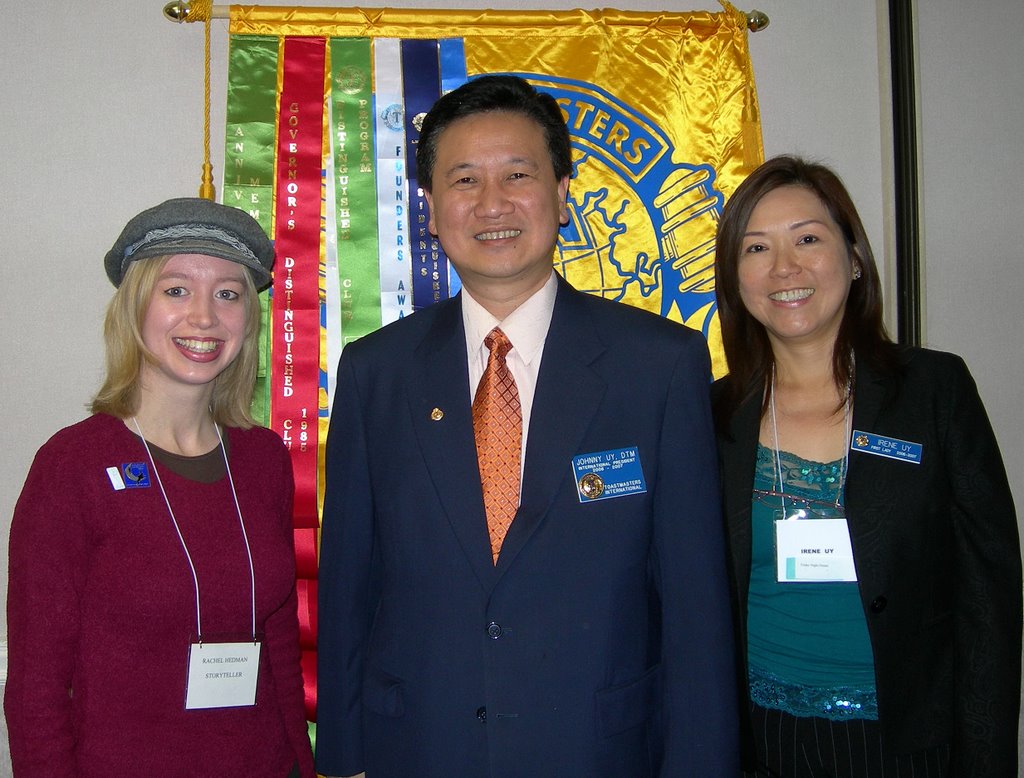
I will never grocery shop the same way as three questions will linger from Johnny Uy’s workshop “Super-Marketing Toastmasters” as part of the Fall 2006 District 15 Conference for Toastmasters International on November 11th. (See picture of Johnny Uy, his wife Irene, and I.)

Three Questions to Apply to Yourself and/or Organization:

  1. Why do you walk in a particular supermarket?
  2. What makes the customers happy so as to continue going to your supermarket?
  3. How does the store stay competitive by meeting the needs of the customers?

Why do you walk in a particular supermarket?
Ask yourself why people go to your storytelling performances. Ask why people attend your storytelling guild/organization. Ask why people go to you.

Advertise
Who has not received coupons from a supermarket every week, if not every day? We cannot expect everyone to happily stumble upon our performance, guild, or organization. Beyond fliers, grocery chains usually have a community board to place posters.

Johnny shared how back issues of the Toastmasters magazine can be placed in strategic places of where people wait. Offices of doctors, dentists, and car mechanics may welcome the “Storytelling Magazine” or other storytelling publications. Upon placement, Johnny urged that the contact info be attractive and in a prominent place. Otherwise it would be like dangling a carrot and no way to get more carrots.

Part of Nationwide Chain
For over 82 years, Toastmasters continues its tradition of communication and leadership training. This organization consistently grows year by year, with now more than 211,000 members, due to how it uses its credibility.

How long has storytelling been around? We could say storytelling was around as soon as humans could speak. In regards to organizations, we have the National Storytelling Network, the International Storytelling Foundation, Utah Storytelling Guild, etc. Let us be proud of our heritage.

How about you as an individual storyteller? I am now on my 13th year as a storyteller as my path started as a high school sophomore. Remember that you have your own history—whether it started today or over half a century ago.

There can always be fallout of membership/attendees. When Toastmasters loses a member, they conduct an exit survey. Johnny said that 100% of exiting members left happy and satisfied, meeting their goals. This respect will promote Toastmasters, even when the member is not active.

With the respect as a performer or as a group, publicize major activities. The National Storytelling Network asks for location submissions of Tellabration!, a world-wide event of storytelling over the course of a weekend. Take advantage of such service.

Happens to be Convenient/Meets Immediate Need
How close is the grocery store at which you shop? Most likely, people want to attend performances, guilds, and organizations within certain areas. Make it easy for people to find where you will be for meetings and concerts.

As for immediate need, perhaps you know someone who will give a major presentation. Johnny suggested approaching graduate students who must defend dissertations. Storytelling is a communication skill and you may be able to draw people to your meetings with that thought.

What makes the customers happy so as to continue going to your supermarket?
So you entered the doors of the supermarket. Who is to say you will continue shopping there?

Customers Greeted/Personnel Treat Customers with Courtesy
Some places have an official greeter so that customers feel welcomed. Do you welcome people as they attend your concert? I have always believed in “Go early, stay late.” Do you welcome people as they attend your guild/organization? Even if someone sits in a corner on their own accord, do not let them go home friendless.

Personnel Help Find Needs/Advise on Products
Johnny says that in Toastmasters there is supposed to be a coach/mentor assigned for every new member. What if storytellers applied the same principle? If someone is new to the art of storytelling, some kind of orientation outside of the guild meeting with the mentor could build loyalty in no time.

Johnny adds that it should be checked to see if the coach/mentor is actually doing the job. Simply appointing two people together does not guarantee progress.

Maintains Database of Customers
Some grocery stores keep databases so as to send specific coupons to customers. What are the types of “coupons” you give?

Storytellers may have databases for different reasons. I keep emails of storytellers and story appreciators so I can send a listing of Utah storytelling events open to the public as well as to let them know about my latest blog entry.

Storytelling guilds/organizations should have an updated list of their members and keep in touch with them. Show the members that you know that they exist.

If someone was absent at the last meeting, do leaders find out why the member was missing? Missing one meeting can lead to two meetings, which makes it easier to miss three times and so on. Have your members feel important. Attendance will surge.

Complete Line of Products/Food (so don’t go elsewhere)
Toastmasters offer varied, stimulating and complete educational programs to help their members develop communication and leadership skills. Can you say the same thing?

Professional storytellers tend to do more than mere entertainment when performing. Many tellers prefer to have their audience inspired or influenced in some way. When at a guild meeting, there must also be growth like in leadership skills of members and topics that are of interest.

Johnny emphasized that a gathering is complete when there is fun. He suggested that themed meetings, like holding a Halloween one at the cemetery, could bring excitement. There are times to be serious, though rarely at a guild meeting. This is a time to share stories and ideas that can build each other beyond business and into friendships.

Aggressive Pricing
Toastmasters have 2-for-1 offers in that new members receive two manuals to guide them in communication and leadership skills. The manuals alone would make the monthly dues of minimal consequence.

As Co-Chair of the Youth, Educators, and Storyteller Alliance, I look for ways to keep the members happy. We have a website with our online database so members can network. Recently, members received a beautiful YES! pin and pen. They have discounts for Pre-Conference. I expect our list of benefits to increase in time.

How does the store stay competitive by meeting the needs of the customers?
People have unending choices on how and where they spend their time. Always be grateful to those to come to your performance, guild, or organization no matter how large or small.

Survey Other Supermarkets
Visit other performing artist concerts, clubs, and organizations. You can always get ideas from them of what ways build success. Though I am not a member of Toastmasters, I learned from their Conference. I respect Toastmasters to such degree that I would recommend their organization to anyone.

Johnny was asked how many organizations in which he was a member. He smiled and said he belonged only to Toastmasters though he “visits” many other groups. Then Johnny said that he invited other organizations to his organization so he can get their feedback. An outsider’s perspective could notice things to which long-time members are oblivious. Even better, there can be speaker exchanges. Wouldn’t a Toastmaster be a great speaker for a storytelling guild and vice versa?

Joint Promotions with Supermarkets
Though Toastmasters is a strong organization, they enjoy combining efforts in shared causes with other groups such as the Kiwanis. This can promote camaraderie and goodwill with other clubs. There can even be joint meetings or joint induction ceremonies.

When I was president of the Brigham Young University Storytelling Club, we joined performances with “cousin clubs” such as Y Juggle to put on the event “Once Upon a Juggler.” It became a tradition that all enjoyed.

Maintains Cleanliness of Store
Where are you holding your performances or meetings? Johnny says that the room may not be a place filled with cockroaches, though there are others ways for an environment to be wholesome. For example, a person should feel safe when attending. Avoid negative comments and gossip and focus on what is positive about the event/meeting.

Employees Given Sales/Productivity Quotas
Be prepared with a status report on attendance or membership and give an official acknowledgment of numbers at least once a year.

Toastmasters love contests to drive membership. There may be prizes involved though Johnny admits that the bragging rights are most valuable. He recommends that the contests be measurable and will somehow achieve goals of the members. Having a partner for the contest promotes results.

You can brainstorm ways on how you may have contests in connection with your event, guild, or organization.

Efficient Customer Response (ECR), Getting what the Customer Needs at the Time the Customer Needs it
I notice that some grocery stores have comment boxes so as to discover the needs of their customers. The needs determine the inventory. What store wants gallons upon gallons of milk that will go sour?

Johnny recommends conducting a member survey at least every year, if not every six months. Once the interests are found, then meet those needs. Leaders should be willing to listen to complaints from members and to address them in some way.

Remember these insights from Johnny Uy of Toastmasters every time you walk into a supermarket.

If you do, then people will be drawn to your tasty tales and mouth-watering meetings time after time.

Meet the Toastmasters International President:

Johnny Uy—He has been actively involved in Toastmasters for 17 years. He had held many officer positions, beginning at the club level. He moved up through the Toastmaster ranks until his election as International President in August 2006 at the International Toastmasters Convention in Washington D.C. He leads over 211,000 members. He is also president of Pawe Group, Inc. in Cebu City, Philippines.

Until we tell again,

Rachel Hedman
Professional Storyteller
Co-Chair of Youth, Educators, and Storytellers Alliance
(801) 870-5799
rachel@storytellingadventures.com
http://www.rachelhedman.com
http://www.yesalliance.com
Thursday, November 16, 2006

Story & Poetry Slams: 5-Step Evolution of Art


Storytelling and poetry have existed for centuries and now these art forms have evolved into something more intense and lively. Story slams and poetry slams outreach mainly to high school students and college-aged adults, though all ages, cultures and races participate.

My inner radar sounded off when I first heard these evolved art forms. I anxiously attended a poetry slam workshop/contest led by Tracie Morris and Jean Howard at the 9th Annual Great Salt Lake Book Festival on October 28, 2006. Tracie and Jean shared the basic format of a poetry slam. I searched other sources to find what aspects are common.

Format of Story Slam/Poetry Slam (may differ from event to event)—

  1. Anyone Can Share Poem/Story
  2. No Props or Costumes
  3. Five Judges from the Audience and/or Pre-determined Panel
  4. Time Limit
  5. Audience Reactions
Anyone Can Share Poem/Story
All are welcomed to perform and so all types of genres are shared—tall tales, legends, scary stories, romances, hip-hop, social injustices, and the list goes on. Events may censor what can be shared, though most tend to be open to any theme, expression, or style. Some slams may not be appropriate for children 12 years of age and younger.

How is a slam different from an open mike? A slam’s first priority is to the needs of the audience. An open mike is seen as a network of supporters for the artist.

Marc Smith noticed that some open mikes needed a breath of life into them as some participants droned on without connecting to the audience. Marc partnered with Dave Jemilo, owner of a Chicago jazz club called the Green Mill; they created the Uptown Poetry Slam held every Sunday night ever since July 25, 1986. Now, the Green Mill is known as the Mecca of Poetry Slam.

Slams occur mostly in taverns and coffee shops, though other venues sponsor these contests such as festivals, bookstores, libraries, and even Humanities classes. The Ruth Lilly Hoosier Storytelling Festival in Indianapolis had their 3rd Annual Story Slam in October 2006 and awarded $100 to first place and $50 to second place.

No Props or Costumes
Though I have not seen why props and costumes are discouraged, I suspect it is so the audience can focus on the words and the performance. Perhaps another reason would be that props and costumes might give unfair advantage to participants.

Five Judges from the Audience and/or Pre-determined Panel
Random selection from the audience can give anyone a chance to be a judge. No previous experience in judging is necessary. Jean Howard suggests that a pro slam poet gives the first performance, drawing hearty response from the audience, so that the judges can practice giving scores. Of course, this can calm—or terrify—the amateur slam poets.

Poetry slams have either a 0-to-10 scale or a 1-to-10 scale (with 0 or 1 being low). Rarely are perfect 10s given. Out of the five judges’ scores, the highest score and the lowest score are dropped. The three remaining scores are totaled so that the contestant receives a grand total of 0 to 30 points.

Tracie Morris confessed that some slam poets have the performance skills but lack the quality in the poem itself. Judges may let some less-than-desirable pieces slide due to stage presence, though contestants should not expect this to always be the case. There is no telling what piece will grab the judges. What can win in one round may stink in another round.

The Ruth Lilly Hoosier Storytelling Festival’s Story Slam prefers to have a pre-determined panel that includes professional storytellers, teachers, and students. Scorecards are divided into five main categories—

  1. Presentation Skills
  2. Creativity
  3. Staying within Time Limit
  4. Audience Applause/Approval
  5. Story has Beginning, Middle and End

After the event, contestants receive copies of the evaluation forms.

Time Limit
More people can participate when there are time limits. According to Poetry Slam Inc. and the National Poetry Slam, each person has a three-minute limit with a ten second grace period. As for Story Slams, the tales should stay under five minutes. Any second over the allotted time and points are deducted from the judges’ scores.

Audience Reactions
Jean Howard said that when she acts as emcee for a slam, she teaches the audience how to react. She practices with them on how to boo, hiss, and stomp feet. This way, the audience will be more vocal and bring more excitement to the event. Applause may be a rarity.

Tracie Morris noticed, “Sometimes the best response is for people to not like your work.” Difficult or controversial themes are often unleashed. Perhaps the performer’s intent is to have the audience react, despite if the reaction is positive or negative.

Regardless of themes, audiences interpret your body language. Tracie pointed out that doing a particular gesture once, like throwing down your fist, might be more powerful than if done repeatedly.

Beyond gestures, Tracie likes to take out the rhyme in her poems to see if she still likes her work. Tracie warned, “After the 15th person uses rhyme, the audience gets fatigue.”

Audience fatigue can be avoided if a poet/storyteller develops writing skills. Tracie stressed that you “learn how to write well by reading.” Books keep you well versed in ideas so you can create your own ideas. Plus, reading may inspire which lines of poetry—or parts of a story—you may want to prioritize.

If you want to be part of a story/poetry slam—whether as performer, judge, emcee, or audience—most likely there is an event in your neighborhood or nearby city.

As for Salt Lake City, you can go to a poetry slam at A Cup of Joe’s on 353 West 200 South every Saturday at 8:00pm. I met some people who would love to have storytellers so you may find that a poetry slam can be a story slam and a story slam can be a poetry slam.

On a grander scale, you can go to the 2007 St. Louis National Storytelling Conference for its Story Slam or to the 2007 National Poetry Slam in Austin, Texas.

The final step of the evolving art of storytelling and poetry may be the time when those two art forms become one.

Until we tell again,

Rachel Hedman
Professional Storyteller
Co-Chair of Youth, Educators, and Storytellers Alliance
(801) 870-5799
rachel@storytellingadventures.com
http://www.rachelhedman.com
http://www.yesalliance.com